
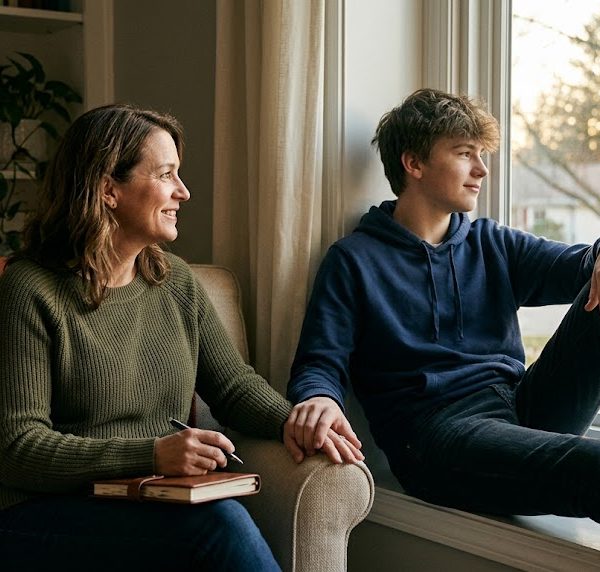
It’s Sunday and the house is quieter than it used to be. With one son already out in the world, and another preparing to leave the nest, I find myself reflecting on the years gone by—and asking: What truly matters in the legacy we leave our children?
Last week, I had the privilege of being invited to speak to middle-year students at an international school here in Hong Kong. The topic was “Overcoming stress during exams.” As I stood there looking at these bright, capable young minds, I couldn’t help but notice something deeper than just exam anxiety.
I saw pressure.
I saw fear of failure.
I saw children already measuring their worth through performance.
And it stayed with me long after I left.
Because as a mum, I kept asking myself:
What are we really preparing our children for?
Is it perfect grades?
The “right” extracurriculars?
A place at a top university?
Or is it something far more fundamental—and far more lasting?
Over the years, both as a parent and as someone who coaches women through life’s uncertainties, I’ve come to believe this:
Our greatest responsibility is not to raise successful children
It is to raise resilient ones.
Children who know how to navigate stress—not avoid it.
Children who can fail—and not fall apart.
Children who can stand back up after disappointment, without losing their sense of self.
Because life will test them.
In ways no curriculum ever can.
As parents, we often carry the silent pressure of “getting it right.”
We worry about whether we’re choosing the right school, the right activities, the right subjects.
I’ve been there too.
I’ve questioned my decisions.
I’ve compared.
I’ve wondered if I’m doing enough.
But somewhere along my own journey—from corporate life to entrepreneurship, from structure to uncertainty, from knowing to figuring it out—I realised something that changed how I show up as a mother.
The most valuable thing I can give my child is not a perfectly planned future.
It is the inner strength to create one.
Mental fitness—the ability to pause, to respond instead of react, to quiet self-doubt, to move through fear—is not something they will magically learn later in life.
It is something they absorb from us.
In how we handle stress.
In how we speak to ourselves.
In how we respond when things don’t go as planned.
They are always watching.
So perhaps, instead of asking:
“Are they achieving enough?”
We begin asking:
“Are they becoming resilient enough?”
Instead of overprotecting them from every difficulty, instead of laying the carpet before each step, what if we allowed them the space to fall—to learn through their mistakes while we are still there to guide them?
To help them discover the tools they need to navigate life when things don’t go their way.
Because one day, they will leave the nest.
And when they do, their grades won’t sit beside them in moments of failure.
Their list of activities won’t comfort them in uncertainty.
But their mindset will.
Their ability to believe in themselves will.
Their capacity to navigate discomfort will.
That is the legacy we leave behind.


Leave a Comment